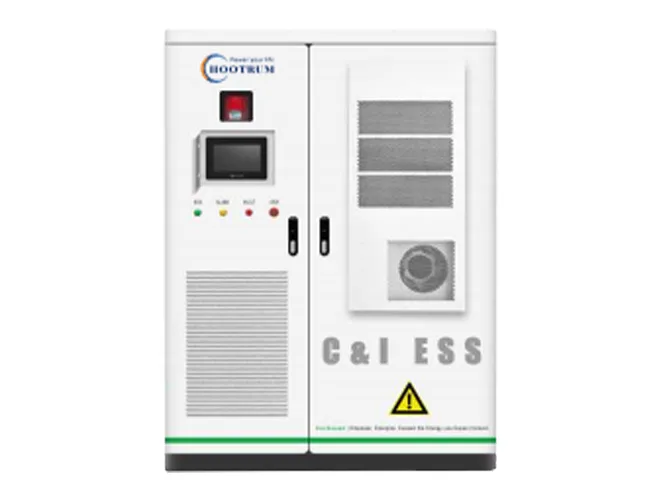
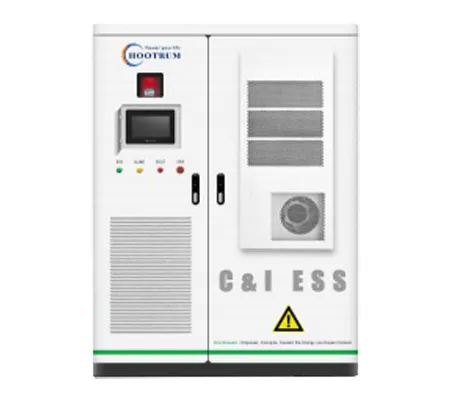
Our commercial and industrial energy storage system integrates high-efficiency batteries with intelligent management, enabling enterprises to achieve peak-valley arbitrage, demand management, and backup power supply. Safe, reliable, and scalably designed, it significantly reduces electricity costs, enhances energy efficiency, and provides sustainable power support for factories, parks, and commercial facilities.


Low cost and high returns
Integrated Design: Simplifies transportation, installation, and maintenance, saving time and money.
Preassembled Unit: Factory pre-assembly minimizes on-site work, reducing installation effort and costs for robust commercial solar battery storage systems.
Cost Savings: Significantly reduces transportation, installation, and maintenance costs.
Stable, Low-Cost Power: Provides reliable and affordable power, maximizing your long-term return on investment.
Efficient and flexible
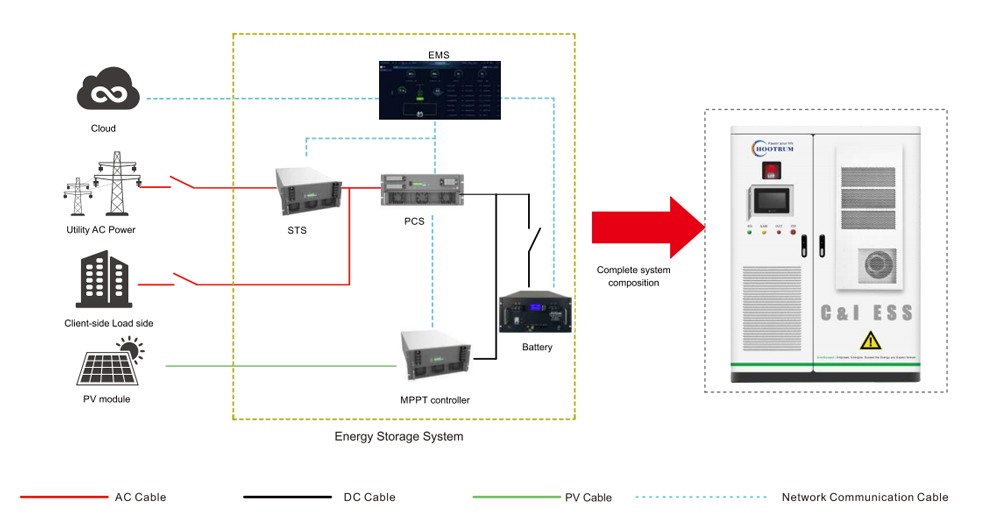
Seamless Power Integration: Easily connect to solar and diesel generators for uninterrupted, low-cost power around the clock.
Optimized Cooling System: Intelligent air conditioning improves efficiency and extends battery cycle life.
Scalable Design: The modular architecture supports multiple parallel connections, allowing the system to be easily expanded based on your needs.
Strict safety regulations and high reliability
Comprehensive Safety Protection: Four layers of safety measures, each with its own independent system, provide enhanced protection.
Long-Term Durability: Lithium batteries with over 10,000 cycles ensure the longest lifespan of your energy storage system (ESS).
Advanced Intelligent Management: Overcharge, over-discharge, overload, over-temperature, low-temperature, and short-circuit protection provide peace of mind.
Easy to implement and easy to manage
Intelligent Management System: The Energy Management System (EMS) and Battery Management System (BMS) provide simple, intuitive energy control.
Real-time Monitoring: Rapid fault detection and early warnings enable quick response to issues, minimizing downtime.
Cell Consistency: Intelligent cell balancing technology ensures consistent performance throughout the battery life, optimizing return on investment.
Models | CO20K-64E |
Electrical Parameter | |
Nominal AC Power | 20 kW |
Grid Type | 3W+N |
Nominal Grid Voltage | 400 VAC |
Nominal Grid Voltage Range | 360 VAC - 440 VAC |
Nominal Grid Frequency | 50 Hz / 60 Hz |
Nominal Grid Frequency Range | 45 Hz - 55 Hz / 55 Hz - 65 Hz |
Rated AC Output Current | 28A |
Max.THD of Current | <3% (at nominal power) |
Battery Parameter | |
Cell Chemistry | Lithium Iron Phosphate (LFP) |
Battery Voltage | 204.8VDC |
Battery Ampere Hour Capacity | 314Ah |
Battery Energy Capacity | 64kWh |
Duration @ Rated Power | 3 hrs |
Cycle Life | 12000+ cycles |
Calendar Life | 20 + years |
Compliance | IEC62619 , UL9540A , UL1973 , UN38 .3 |
Mechanical Parameter | |
Monitoring System | Energy Management System |
Cooling Method | Air-Conditioner |
Fire Fighting System | Yes |
Noise Emission | ≤75dB |
Communication Interfaces | Ethernet, RS485 |
Operating Temperature Range | -20℃ to 50℃ (>45℃ derating) |
Allowable Relative Humidity Range | 0 - 95 % ( non-condensing) |
Ingress Protection( IP) Rating | IP55 |
Max. Working Altitude | 3000 m |
Dimensions (W* D* H ) | 800x1100x1850mm |
Weight | 680kg |
Solar Parameter (optional) | |
Max . pv Input Power | 24kW |
Max. PV Input Voltage | 19.2VDC+19.2 VDC |
MPPT Voltage Range | 200VDC~800VDC |
Number of MPPT | 1 |
Number PV Input of Per MPPT | 2 |
Max. Current Per PV Input | 32A+32A |

1. Peak Shaving and Valley Filling - Direct Electricity Cost Savings
Scenario: Enterprises with high electricity consumption located in regions with significant peak-off-peak electricity price differences.
Value: The system automatically charges during off-peak/low-rate hours and discharges during peak/high-rate hours for self-use, leveraging tariff differentials to directly reduce electricity expenses and generate steady returns.
2. Demand Management - Reducing Capacity Charges
Scenario: Electricity bills include "maximum demand" clauses—short-term power spikes lead to additional high costs.
Value: The system intelligently discharges during peak power periods, smoothing overall electricity consumption curves ("peak shaving and valley filling") to effectively lower maximum demand and reduce capacity charges.
3. Backup Power - Ensuring Critical Operations
Scenario: Production lines, data centers, cold chain storage, precision manufacturing, and other settings requiring extremely high power continuity.
Value: Provides seamless emergency power switching to keep critical loads running uninterrupted, avoiding losses from production halts, equipment damage, or spoiled products due to unexpected outages.
4. Demand Response - Earning Policy Incentives
Scenario: Grid operators initiate demand response programs, encouraging users to reduce grid consumption during tight supply periods.
Value: Enterprises can use energy storage to participate in demand response, discharging to the grid or reducing consumption during specific periods to obtain grid subsidies or electricity bill incentives, creating a new revenue stream.
5. Enhancing Renewable Energy Utilization- Building a Green Enterprise
Scenario: Companies have installed rooftop PV but suffer from low self-consumption rates and poor compensation for excess feed-in.
Value: The system stores surplus solar energy for use at night or on cloudy days, significantly increasing PV self-consumption, reducing grid purchases, cutting carbon emissions, and enhancing green branding.
6. Microgrid Operation- Improving Energy Independence
Scenario: Industrial parks, remote factories, or areas with unstable grids seeking to establish relatively independent microgrids.
Value: Energy storage serves as a core stability unit in microgrids, working synergistically with PV, diesel generators, etc., to balance renewable fluctuations and enhance power reliability and independence.

 English