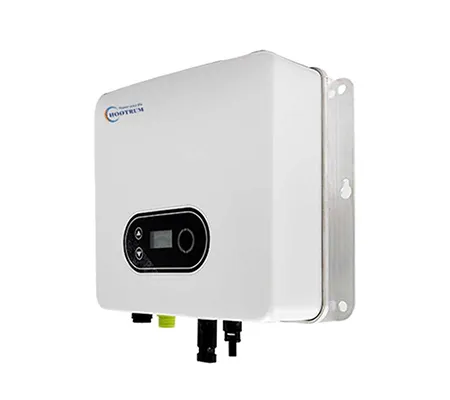
A 5kW, 8kW, or 10kW hybrid inverter should be selected by the site’s maximum simultaneous demand, surge loads, electrical phase, battery discharge capability, PV design, and backup objective rather than by monthly electricity consumption alone.
As a starting point, 5kW is commonly considered for moderate residential loads and small backup circuits, 8kW for larger homes or light commercial sites with more simultaneous equipment, and 10kW for high-demand homes, workshops, small commercial buildings, or projects that need more charging and backup power. These are planning categories, not universal rules. A home with a large heat pump, well pump, induction cooker, and electric water heater can require more instantaneous power than a small shop with higher monthly energy use but a flatter load profile.
The most reliable selection process begins with a load schedule. Record each important appliance or machine, its running power, startup behavior, operating hours, and whether it must stay online during an outage. Then compare the resulting profile with the inverter’s continuous output, overload curve, phase limits, battery current, backup-port rating, and derating conditions.
Hootrum offers single-phase and three-phase hybrid inverter families across multiple power classes. The correct product is the one that matches the complete system architecture, not merely the nearest number in the model name.
This comparison table summarizes the typical design questions associated with the three power classes and should be refined using the exact Hootrum model datasheet.
| Selection Factor | 5kW Hybrid Inverter | 8kW Hybrid Inverter | 10kW Hybrid Inverter |
|---|---|---|---|
| Typical project profile | Moderate home, small office, selected-load backup | Large home, villa, retail, farm office, light workshop | High-demand residence, workshop, restaurant, small commercial building |
| Continuous AC power | Approximately 5kW class | Approximately 8kW class | Approximately 10kW class |
| PV array design | Moderate rooftop array; verify model-specific DC oversizing | Larger array and more daytime load; multiple roof planes may need more MPPT flexibility | Higher PV throughput; string voltage, current, and full-power range become more critical |
| Battery requirement | Must support planned 5kW-class discharge if full output is expected | Higher battery current or higher-voltage architecture may be required | Battery power and cable/protection design are decisive |
| Surge loads | Suitable only if motor starts fit overload curve | More headroom for pumps, compressors, and simultaneous household loads | Better fit for heavier combinations, subject to model overload duration |
| Phase considerations | Often single phase | Single or three phase depending on market and load | Single, split, or three phase depending on electrical service |
| Best buyer question | Which loads must run together? | How much expansion and backup headroom is required? | Can the battery, wiring, and phase distribution support the full rating? |
Rated power is only one row in the decision. If a 10kW inverter is paired with a battery that can continuously deliver only 5kW, the system may not provide 10kW from storage. If the backup output is lower than the main output, the full rated power may not be available during an outage. If ambient temperature causes derating, the continuous output can also be lower than the label under actual conditions.
A real load profile is a time-based record of how much power a site uses, which loads overlap, and which loads must operate during normal and outage conditions.
Begin with interval data when available. Smart-meter or energy-monitor data at 1-minute, 5-minute, or 15-minute resolution is more useful for inverter sizing than a monthly bill. The bill shows energy in kilowatt-hours, while the inverter must serve power in kilowatts at each moment. A household using 900 kWh per month may have a peak demand below 5kW or above 12kW depending on equipment and behavior.
Separate loads into four groups. The first group is continuous base load, such as refrigeration, routers, controls, lighting, and standby equipment. The second is scheduled load, such as water heating, laundry, charging, or industrial processes that can be shifted to solar hours. The third is variable comfort or process load, such as air conditioning or pumps. The fourth is surge load, including motors, compressors, and transformers that draw more power during startup.
Also create a backup version of the profile. During an outage, the site may not need every appliance. A 10kW main service can sometimes be supported by a 5kW inverter if only essential circuits are connected to the backup output. Conversely, a nominal 5kW backup plan may fail if one pump requires a high startup current and the inverter’s overload curve is insufficient.
For B2B projects, ask the end user to approve the load list. This prevents a supplier from being held responsible for unreported equipment added after commissioning.
A 5kW hybrid inverter is best suited to projects whose simultaneous load, surge demand, battery power, and expansion plan remain comfortably within a 5kW-class system.
Typical applications include apartments, moderate detached homes, small offices, guardhouses, communications rooms, small shops, and critical-load backup panels. The system may serve refrigeration, lighting, electronics, fans, a modest air conditioner, and other selected loads, but the exact combination must be calculated.
Consider an example in which the backup panel includes a 200W refrigerator average load with a higher startup surge, 300W of lighting, 250W of internet and office equipment, a 1.2kW air conditioner, and 800W of miscellaneous intermittent loads. The normal combined demand may stay below 3kW, leaving margin within a 5kW inverter. If a 2kW pump starts at the same time as the air conditioner, however, the surge curve becomes the deciding factor.
A 5kW hybrid inverter can also be attractive for distributors because it fits a broad residential segment. To avoid returns, the sales process should state the supported battery voltage, PV limits, MPPT arrangement, backup power, and installation environment. “5kW” must not be marketed as a universal whole-home solution.
The 5kW class may be preferable to a larger inverter when the utility export limit is low, the battery is small, the PV array is modest, the service capacity is limited, or the customer values lower standby consumption and system cost more than future expansion.
An 8kW hybrid inverter is a middle-capacity option that can provide more simultaneous-load and PV headroom without moving every project into a 10kW-class architecture.
This class is often considered for large homes, villas, rural residences with pumps, home offices with air conditioning, small retail sites, clinics, farm buildings, and light workshops. It can be useful when a 5kW design would operate near its continuous limit for long periods but a 10kW system would add cost that the battery and PV array cannot fully use.
Suppose a property has a 1.5kW base load, two air conditioners that may draw 2.5kW together, a 1.2kW water pump, and intermittent kitchen or workshop loads of 2kW. The realistic peak can approach 7kW, even though the daily average is much lower. An 8kW system may provide a practical margin if the overload and phase behavior are suitable.
The 8kW hybrid inverter class also allows a larger PV array where model specifications permit. This can improve solar coverage of daytime loads and battery charging. The designer must still check whether all PV power can be used simultaneously, whether battery charge current becomes the bottleneck, and whether export limits will cause frequent curtailment.
An 8kW inverter is not automatically more efficient than a correctly loaded 5kW model. Oversizing the inverter relative to the site can increase time spent at low load, while undersizing can cause clipping or overload. The best option keeps the expected operating range within an efficient and reliable part of the product envelope.
A 10kW hybrid inverter makes sense when the site has a verified high simultaneous load, a sufficiently capable battery and PV system, suitable electrical service, and a clear need for the additional output.
High-demand homes may reach this range when several air conditioners, electric cooking, water heating, pumps, EV charging, or workshop equipment overlap. Small commercial sites may need 10kW for refrigeration, kitchen equipment, point-of-sale systems, lighting, office loads, or process equipment. Rural properties may combine household demand with irrigation or livestock equipment.
The design should not assume the inverter can run every load simply because their nameplate sum is below 10kW. Motor starting, phase allocation, power factor, temperature, altitude, backup-port limitations, and battery current all affect usable performance. A three-phase 10kW unit may also distribute power across phases in a way that limits a single-phase load.
A 10kW system often requires more attention to conductor size and protection. At approximately 48V battery voltage, 10kW corresponds to more than 200A before losses. Actual DC current can be higher depending on voltage and efficiency. This illustrates why low-voltage high-power systems need short cable runs, appropriate cross-section, correct lugs, torque control, fusing, busbars, and thermal management. High-voltage battery architectures reduce current but introduce different equipment and safety requirements.
For Hootrum projects, the 10kW class can be selected from relevant single-phase, split-phase, or three-phase product families depending on the market. The inquiry should identify the required architecture before model selection.
A hybrid inverter sizing formula is a planning method that combines continuous load, diversity, surge demand, design margin, battery output, and phase constraints.
A simplified continuous-power calculation can be expressed as:
Required inverter output ≈ expected maximum simultaneous running load × design margin.
If the measured maximum simultaneous running load is 4.2kW and a 20% planning margin is used, the result is approximately 5.04kW. This indicates that a nominal 5kW unit may be at the boundary and an 8kW model may provide better headroom. The margin is a design choice, not a universal standard, and should not replace review of the overload curve.
For another site, assume a normal maximum of 6.1kW, a short 3kW motor start, and a target of keeping the inverter below 85% of rating during common peak periods. Dividing 6.1kW by 0.85 gives approximately 7.18kW, which points toward the 8kW class. The motor start must then be checked against the exact overload duration and other loads that remain active during startup.
For a small commercial site with a measured 8.2kW peak, expected future load growth of 1kW, and no ability to shed loads, a 10kW class may be appropriate. If the battery can deliver only 6kW, grid-connected operation may still support the full load by combining sources, but battery-only backup will be limited. This distinction should be written into the project specification.
Do not use one formula for all systems. Grid-tied self-consumption, whole-site backup, selected-load backup, off-grid operation, and peak shaving have different sizing priorities.
Battery capacity should be sized by required runtime and usable energy, while battery power should be sized by the inverter’s expected charge and discharge demand.
For runtime, a simplified planning equation is:
Nominal battery energy = load × backup hours ÷ usable fraction ÷ conversion efficiency.
If a 2kW critical load must run for four hours, the delivered energy is 8kWh. Assuming a 90% usable fraction and 92% combined discharge and inverter efficiency for planning, nominal energy is approximately 8 ÷ 0.90 ÷ 0.92 = 9.66kWh. A designer may select a larger nominal capacity to cover aging, temperature, reserve state of charge, and unexpected loads.
For power, check the battery’s continuous and peak discharge current. A 5kW inverter operating near full battery output at 51.2V draws roughly 98A before losses. An 8kW output corresponds to roughly 156A before losses, and 10kW corresponds to roughly 195A. Actual current depends on battery voltage under load and conversion efficiency. These simple numbers demonstrate why the BMS, cables, connectors, fuses, and busbars must be evaluated together.
Multiple battery modules may be paralleled to increase energy, current capability, or both, but the inverter must support the configuration and the battery manufacturer’s parallel rules. Unequal cable lengths, mismatched state of charge, mixed firmware, and unbalanced current sharing can create problems.
A larger inverter does not require a fixed battery size. A 10kW inverter might be paired with a smaller battery for short peak shaving, or a much larger battery for long backup. The project duty defines the correct relationship.
Allowable PV capacity is determined by each model’s maximum DC power, voltage, current, MPPT window, and approved oversizing ratio rather than by a simple one-to-one relationship with AC output.
Designers often install more PV nameplate power than inverter AC power because modules rarely operate at nameplate output for long periods. This can improve energy production in mornings, afternoons, winter, or cloudy conditions. However, oversizing can increase clipping during strong sun and cannot exceed the product’s electrical limits.
For each proposed string, calculate the maximum open-circuit voltage at the lowest expected module temperature and verify it remains below the inverter’s absolute maximum. Calculate the minimum operating voltage in hot conditions and verify it stays within the MPPT range. Check operating current and short-circuit current against the limit for each tracker. Bifacial gain and high-irradiance conditions may require additional current consideration.
A roof with east and west arrays may benefit from separate MPPTs. A roof with three different orientations, or with shading on one section, may require three or more independent trackers or a different architecture. Connecting unlike strings to the same tracker can reduce harvest even when total PV wattage appears acceptable.
For B2B quotations, send the module datasheet and string plan. Asking only “How many panels can connect?” is insufficient because panel voltage and current vary widely.
Phase selection defines how inverter power is delivered to the electrical system and is often more important than the difference between 8kW and 10kW.
Single-phase output is common in many residential markets. At higher power, local utilities may limit the maximum single-phase connection or require three-phase service. Split-phase output is used in 120/240V systems, where 120V loads connect from a line to neutral and 240V loads connect across two lines. Three-phase output is used for larger buildings and motor loads.
A three phase hybrid inverter must be evaluated for per-phase output and unbalanced-load capability. A building may have 8kW total demand but place 5kW on one phase. If the inverter allows only a lower per-phase value, the system may overload even when total power is below the nameplate.
For backup, confirm whether the product supports three-phase backup and whether all phases must remain balanced. Some installations move critical loads to a dedicated single-phase backup panel even when the main building is three phase. Others require a full three-phase backup architecture for motors or process equipment.
The product family, grid code, meter arrangement, and neutral/earthing design must match the local market. Phase terminology should be clear in the website navigation so buyers do not confuse split phase, phase loss, and three-phase unbalance.
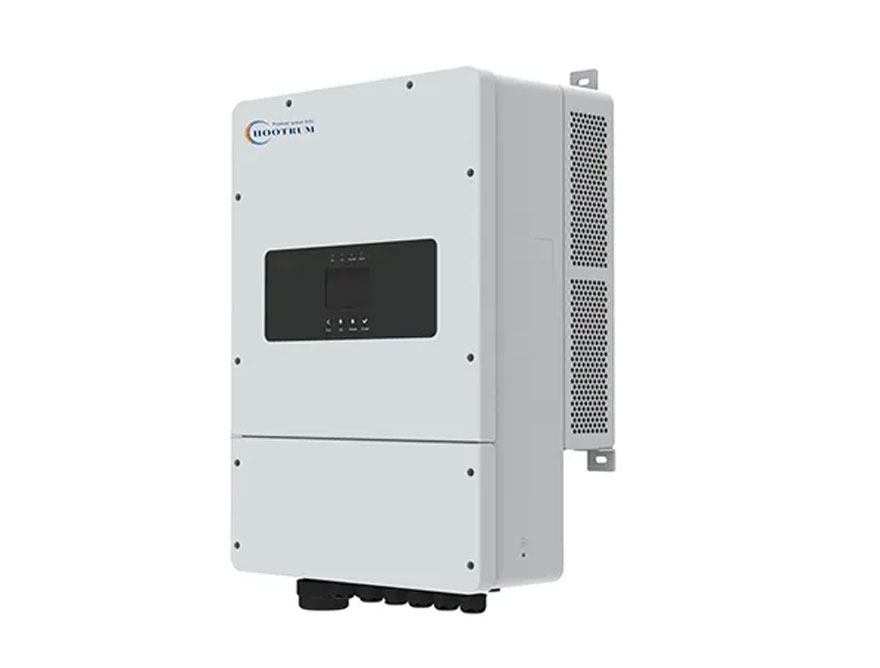
Surge capacity is the inverter’s ability to supply power above its continuous rating for a specified short duration.
Refrigerators, pumps, air conditioners, compressors, workshop tools, and transformers may draw several times their running current during startup. The exact value depends on motor type, control method, mechanical load, and starting system. A soft starter or variable-frequency drive can reduce some starts, but compatibility must be checked.
Do not compare surge claims without duration. “200% surge” for a few milliseconds is not equivalent to 150% for ten seconds. Also verify whether the overload capability applies in grid-connected mode, battery mode, and backup mode. Thermal state and ambient temperature can affect repeatability.
For a site with a 3kW pump that starts at 2.5 times running power, the temporary demand may approach 7.5kW before other loads. A 5kW inverter could fail to start it even if the pump’s running power appears acceptable. An 8kW or 10kW model may be required, or the system may need load sequencing, a soft starter, a dedicated motor drive, or a generator.
The procurement document should identify the largest inductive loads and require sample testing under representative conditions.
Efficiency and clipping describe how effectively the inverter converts available power and how often PV input exceeds its usable AC or charging capacity.
Peak efficiency is achieved at specific voltage and load conditions. A system operates across many power levels, so weighted efficiency, standby consumption, night consumption, and thermal derating can be more useful than one peak number. Hootrum’s hybrid inverter category cites maximum efficiency up to 98.6% for relevant models; the exact model value and test conditions should be confirmed.
Clipping occurs when available PV power exceeds the inverter’s current output or charging/export limit. Occasional clipping may be acceptable in an economically optimized design, but frequent long-duration clipping can indicate excessive DC oversizing or a constrained battery/export strategy.
Oversizing the inverter can reduce clipping but may increase initial cost and time spent at low-load operation. Undersizing can improve utilization but may limit backup power and future expansion. The choice should be modeled using local irradiance, roof area, tariff, export rules, and load profile.
For projects with frequent partial shading or multiple roof planes, energy harvest may depend more on MPPT arrangement and string design than on moving from 8kW to 10kW.
Total project cost includes the inverter, battery, protection, cables, meters, installation, commissioning, compliance, service, and the cost of downtime or redesign.
A larger inverter can require larger conductors, breakers, battery current capability, and possibly a different phase connection. A high-voltage system may reduce DC current but use more specialized batteries and installation procedures. An outdoor installation may need an IP65 or IP66 product, weather protection, clearances, and suitable communication hardware.
Distributors should compare packaging, spare parts, training, firmware control, monitoring access, and warranty procedures. A lower-priced inverter can create a higher lifecycle cost if alarm diagnosis is unclear, replacement approval is slow, or installers require repeated site visits.
Also compare opportunity cost. A 5kW inverter that is too small may force load shedding or early replacement. A 10kW inverter that is too large may tie up capital without increasing usable energy because the battery and PV system remain small. The 8kW option may sometimes be the best commercial compromise.
Request a model recommendation from Hootrum using the same load and system brief for all options. This produces a like-for-like comparison instead of three unrelated quotations.
Sample selection scenarios illustrate how the same monthly energy use can lead to different inverter sizes.
The site has a 1kW base load, one air conditioner, refrigeration, lighting, electronics, and a small pump. Critical loads usually remain below 3.5kW, and the pump can be scheduled. A 5kW system may fit if the surge curve is adequate and the battery can deliver the required power.
The site has several simultaneous comfort loads, a pool pump, kitchen equipment, and future EV charging. Measured peaks reach 6.5kW before EV charging. An 8kW system may fit current needs, while a 10kW system may be justified if future loads are confirmed and the service connection allows them.
Refrigeration, lighting, ventilation, cooking support equipment, and point-of-sale systems overlap. The measured peak reaches 8.4kW, and selected refrigeration must stay online during outages. A 10kW system may be appropriate, but backup circuits and battery runtime must be carefully defined.
Average consumption is modest, but a large pump creates a severe startup demand. A 10kW inverter may still be insufficient if the overload curve cannot start the motor. The correct answer may involve a soft starter, variable-frequency drive, load sequencing, or separate pump supply rather than simply increasing inverter power.
A B2B procurement checklist ensures that the selected power class can be manufactured, installed, and supported consistently in the target market.
Confirm single-phase, split-phase, or three-phase output and local grid code.
Provide a measured or approved load schedule, including motor-start data.
Define normal operation, backup operation, peak shaving, and export control.
Verify model-level PV voltage, MPPT range, current, short-circuit current, and string count.
Confirm battery voltage, communication protocol, continuous current, peak current, and approved models.
Request overload curves with duration and operating-mode conditions.
Check backup output rating, transfer time, phase balance, and black-start capability.
Confirm ambient-temperature and altitude derating.
Review exact certificates, manuals, labels, serial tracking, and firmware version control.
Test a sample with representative PV simulation, battery, loads, meter, and communication.
Agree on packaging, lead time, spare parts, training, warranty, and failure-analysis workflow.
Record the final approved configuration in the purchase order and project drawing.
These frequently asked questions address the most common sizing misunderstandings in residential and small commercial projects.
No. A 10kW model adds output potential but may require a larger battery, more PV, larger conductors, a different grid connection, and higher cost. A correctly sized 5kW system can be more efficient and economical for moderate loads. The decision should follow measured demand and expansion plans.
It can run a whole house only when the home’s simultaneous and surge loads remain within the model’s limits and the phase architecture is suitable. Large electric heating, cooking, pumps, EV charging, and multiple air conditioners may require load management or a larger system.
There is no fixed number. The battery bank must meet both runtime and power requirements. Calculate required kilowatt-hours from backup duration and required kilowatts from discharge power. Then verify module current, parallel limits, communication, and usable state of charge.
Many models allow some DC oversizing, but the permitted amount is model-specific. Maximum PV power, voltage, MPPT range, input current, and short-circuit current must all be respected. Do not infer an oversizing ratio from another model.
Choose 10kW only when future loads, PV capacity, battery power, service capacity, and budget are realistic. If expansion is uncertain, an 8kW system with approved parallel capability or modular storage may offer a better balance. Confirm how parallel operation works in each mode.
Send the target country, phase and voltage, grid code, load schedule, motor loads, PV module and string data, battery requirement, backup duration, installation environment, communication, certification, quantity, and delivery target. Hootrum can then compare the appropriate 5kW, 8kW, and 10kW options.
The difference between a 5kW, 8kW, and 10kW hybrid inverter is not simply three power labels. Each step changes possible load coverage, PV throughput, battery current, cable and protection requirements, phase options, expansion potential, and project cost.
A 5kW model can be the right choice for moderate loads and selected backup circuits. An 8kW model often provides useful headroom for larger homes and light commercial sites. A 10kW model fits verified high-demand applications when the battery, PV array, service connection, and installation are designed to use its capability.
The best way to avoid oversizing or undersizing is to send Hootrum a real load profile and system brief. The resulting recommendation can then be tested against the exact product datasheet, battery compatibility, backup requirement, and local grid rules before bulk procurement.
1. U.S. Department of Energy — Solar Energy and Storage Basics: https://www.energy.gov/cmei/systems/solar-integration-solar-energy-and-storage-basics
2. International Electrotechnical Commission — IEC 62548-1 PV Array Design Requirements: https://webstore.iec.ch/en/publication/64171
3. Wikipedia — Electric Power: https://en.wikipedia.org/wiki/Electric_power
 English