In 2026, commercial solar procurement is no longer evaluated on nameplate capacity alone—it is judged on bankable Solar ROI and LCOE reduction over a 20-plus-year asset life. Yet three structural pressures are quietly eroding returns on conventionally designed systems: rising DC-side safety and compliance costs (arc-fault risk, high-voltage DC audits), growing O&M labor constraints on distributed rooftops, and the inability to capture full energy yield from complex roof geometries with mixed orientations, shading, and soiling.
A hybrid microinverter architecture addresses all three simultaneously. By converting and optimizing power at the individual module level—while preserving a storage-ready pathway for future battery integration—it raises lifetime kWh output, reduces operational risk exposure, and keeps commercial solar inverter cost per delivered kWh on a downward trajectory. The following sections walk procurement teams, EPC engineers, and asset managers through the mechanics, specifications, application fit, and TCO math behind this approach.
The classic string inverter argument is straightforward: lower upfront CAPEX per watt, proven topology, simple commissioning. On a perfectly uniform, unshaded roof with a single orientation, that argument holds. The problem is that most commercial rooftops in 2026 are not uniform.
The LCOE equation has two sides. String inverters minimize the numerator (capital cost) but can inflate the denominator—lifetime kWh—through a well-documented weakness: the entire string performs at the level of its weakest module. One shaded panel, one soiled string, one degraded cell can pull down the output of 20 or more modules simultaneously. Over a 20-year asset life, that hidden yield loss compounds into a material LCOE penalty.
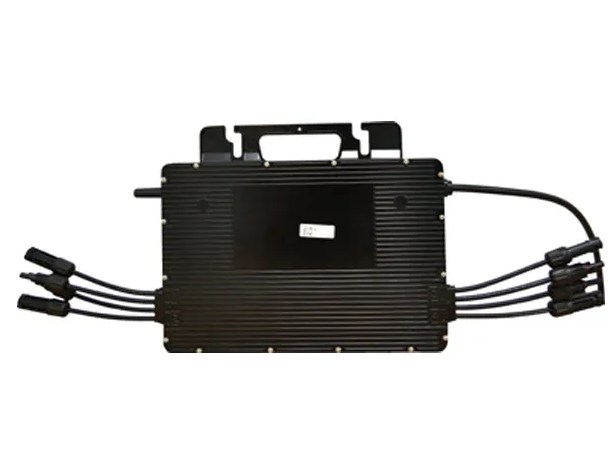
Module-level power electronics change the math. A hybrid microinverter assigns independent MPPT tracking and DC-to-AC conversion to each module (or small cluster of modules). Each unit operates at its own maximum power point regardless of what neighboring modules are doing. The result is a system whose energy output is determined by the sum of individual module potentials, not the weakest link in a series string.
Why "hybrid" matters specifically in 2026 is the storage dimension. Tariff structures are shifting toward time-of-use pricing and demand charge penalties that reward self-consumption and peak shaving. A hybrid microinverter architecture is designed from the outset to accommodate battery storage integration—meaning the system can be commissioned today as a pure grid-tied PV asset and upgraded to include storage later without a costly inverter replacement or switchgear redesign. That optionality has real financial value when modeled against projected tariff volatility.
The conversion path is straightforward at a high level: each module's DC output feeds directly into its dedicated microinverter unit, which converts it to AC at the module. AC outputs from multiple units are combined on a low-voltage AC trunk cable and fed to the building's distribution panel or grid interconnection point. There is no high-voltage DC bus running across the roof.
MPPT accuracy is the yield engine. MPPT tracking accuracy above 99.5% across a tracking range of 22–55 V, with a peak conversion efficiency of 96%. Each unit handles up to four PV panels (275–530 W per panel), meaning a single device manages up to 2,120 W of DC input with independent per-channel optimization. Under partial shading or mismatch conditions—HVAC equipment shadows, parapet shading, soiling gradients—module-level MPPT has been shown in multiple studies to improve energy harvesting by 5–15% compared to string-limited configurations, with gains at the higher end of that range in heavily shaded or complex-geometry installations. These figures are project-dependent and should be modeled against the specific shading profile before being used in financial underwriting.
The DC safety dividend is increasingly relevant to commercial solar inverter cost discussions that include insurance and compliance line items. Because each microinverter converts DC to AC at the module, the high-voltage DC run lengths that characterize string systems are eliminated or dramatically shortened. Maximum DC input voltage is 60 V. This low-voltage DC architecture reduces arc-fault risk exposure and can simplify compliance with evolving electrical safety codes. The actual impact on insurance premiums is site- and policy-specific and should be confirmed with the project's EHS and insurance advisors, but the risk profile improvement is a legitimate input to the TCO model.
Efficient solar storage solutions become accessible without system redesign. Because the AC bus is already established at the module level, adding a battery system involves connecting storage to the AC side rather than redesigning a DC-coupled string architecture. This preserves capital and avoids the "stranded asset" risk of a string inverter that cannot economically accommodate storage.
Procurement teams comparing hybrid microinverter quotes need a consistent parameter set to ensure apples-to-apples evaluation.
System Sizing
Module wattage range: confirm compatibility (supports 275–530 W per panel, 4 panels per unit)
Number of modules and total DC kW
Target AC output and export cap (grid interconnection limit)
Build phases if incremental deployment is planned
Electrical and Grid Compliance
Nominal AC output: 230 V, 50/60 Hz (operating range 190–270 V; frequency range 47.5–51.5 Hz / 57.5–62.5 Hz)
THD: <5%; Power factor: >0.99
Anti-islanding protection: confirm compliance with jurisdiction-specific grid codes
Certifications required by the project authority having jurisdiction
Yield and Monitoring
Module-level monitoring granularity: Wi-Fi/2.4G communication enables per-unit performance visibility
Data retention period and access control
Alarm and fault notification workflow
Environmental and Reliability
Operating ambient temperature: −40°C to +65°C
Ingress protection: IP67
Cooling: natural convection, no fan
Corrosion class: confirm coastal or chemically aggressive environment requirements
Model Selection Reference
The 1.6 kW class suits 4-panel clusters at 275–530 W per panel
Higher-wattage models in the 2.0–2.25 kW class are available for larger module formats
C&I Rooftops with Shade and Mismatch Industrial and commercial rooftops routinely feature HVAC equipment, skylights, parapets, and mixed roof planes with different orientations. In these conditions, module-level MPPT delivers its largest yield advantage over string topology—recoverable production that a string inverter leaves on the table every day.
Multi-Tenant Buildings and Phased Expansion Modular architecture supports incremental capital deployment. A building owner can commission Phase 1 and add Phase 2 without replacing the inverter infrastructure. Each microinverter unit is independent; adding capacity means adding units, not redesigning the system.
Storage-Forward Sites Facilities with high demand charges, time-of-use tariff exposure, or backup power requirements benefit from designing the storage pathway into the initial system. A hybrid microinverter architecture preserves this option at low incremental cost via AC-coupled storage integration.
High Compliance and Accountability Environments Data centers, healthcare facilities, and other regulated environments face heightened scrutiny on electrical safety and system documentation. Module-level monitoring provides a continuous, auditable performance record, while the low-voltage DC architecture reduces arc-fault event severity.
Define the financial target. Establish LCOE target, payback period, and the tariff structure driving value (demand charge rate, TOU premium, net metering rate).
Model yield uplift conservatively. Commission a shading analysis and apply the 5–15% yield gain only to the portion of the array genuinely affected by shading or mismatch.
Design for safety and compliance from day one. Map AC trunk cable routing, confirm anti-islanding settings, and document monitoring access control policy.
Decide the storage pathway. Determine whether battery storage is immediate or planned; reserve switchgear capacity and control interface accordingly.
Commission with verification. Acceptance testing should include per-unit output verification via the monitoring platform to establish the baseline performance record.
Modular O&M reduces truck roll cost. A single unit failure affects only the 1.6 kW associated with that device—the remaining array continues producing. The failed unit is identified remotely and replacement is a plug-and-play field operation, materially reducing annual O&M cost on distributed rooftops.
Performance transparency eliminates hidden yield loss. Module-level monitoring surfaces soiling gradients, partial shading events, and early-stage degradation that aggregate string-level monitoring misses. Faster root-cause diagnosis means faster corrective action.
Risk cost control improves EHS and insurance line items. Fewer high-voltage DC exposure points, IP67 protection, and natural-cooling design (no fan) reduce incident probability and eliminate a common failure mode. These factors should be quantified in the project's EHS risk register and discussed with the insurer.
If your commercial PV project's Solar ROI is being constrained by shading and mismatch losses, O&M labor costs, DC-side compliance exposure, or the inability to add storage without a costly redesign, a hybrid microinverter architecture addresses each of these levers directly. Module-level MPPT with >99.5% tracking accuracy, a low-voltage DC architecture (max 60 V), IP67 protection, natural cooling, and Wi-Fi module-level monitoring combine to deliver higher lifetime kWh, lower service complexity, and a storage-ready platform—the three core drivers of LCOE reduction in 2026 commercial PV.
Visit the Hootrum Hybrid Microinverter product page to review the full model range and request a recommended configuration and quotation.
To receive an accurate recommendation, please submit the following project information:
Work condition: Rooftop or carport type, shading profile, soiling level, ambient temperature range, coastal or corrosive environment (Y/N)
Quantity: Number of modules, total DC kW, expected build phases
Size/spec: Module model and wattage, grid voltage and frequency, interconnection limit, switchgear constraints
Target metrics: LCOE target, payback period, yield gain target, uptime requirement, monitoring and cybersecurity requirements
Current problem: Underperformance vs. forecast, string downtime, frequent truck rolls, safety audit findings, planned storage retrofit, demand-charge exposure
1. What is a hybrid microinverter?
A module-level inverter that performs DC-to-AC conversion and MPPT optimization at each PV module, with a built-in storage-ready architecture that supports battery integration—either immediately or as a future upgrade—without redesigning the system.
2. Hybrid microinverter vs. string inverter vs. optimizer + string: which is best?
String inverter: lowest CAPEX, best fit for uniform, unshaded single-orientation arrays.
Optimizer + string: module-level MPPT with centralized inversion; mitigates mismatch but retains a high-voltage DC bus and a central single point of failure.
Hybrid microinverter: module-level conversion, no high-voltage DC bus, storage-ready; strongest value where shading, mismatch, O&M visibility, and storage optionality all matter.
3. How does it lower LCOE and improve payback?
Two levers: more lifetime kWh (5–15% yield uplift from module-level MPPT under mismatch/shading) and lower annual O&M cost (modular replacement, faster fault diagnosis, no-fan design). Both move LCOE in the same direction. Actual payback depends on site complexity, labor rates, and tariff structure.
4. Does retrofitting an existing site require a full redesign?
Not a full redesign, but some electrical work is typically needed—AC trunk cable routing, interconnection point review, and switchgear capacity check. Start with a retrofit assessment: shading map + single-line diagram review + switchgear audit.
5. What parameters are needed for an accurate selection and quote?
Module model and wattage, total module count, grid voltage and frequency, shading/mismatch profile, export cap, ambient temperature range, coastal environment (Y/N), monitoring requirements, storage scope (immediate or planned), and target LCOE and payback period.
 English